


The European Commission has notified a draft Implementing Regulation concerning the approval of ethanol (EC No. 200-578-6; CAS No. 64-17-5) as an active substance for use in biocidal products belonging to Product Types (PTs) 1, 2 and 4 under Regulation (EU) No 528/2012, the Biocidal Products Regulation (BPR).
The proposal represents a further step in the substance approval process, following the opinion issued by the European Chemicals Agency’s (ECHA) Biocidal Products Committee (BPC) in February 2026. The BPC supported the approval of ethanol for the three Product Types concerned, while the final decision rests with the European Commission.
Intended Uses
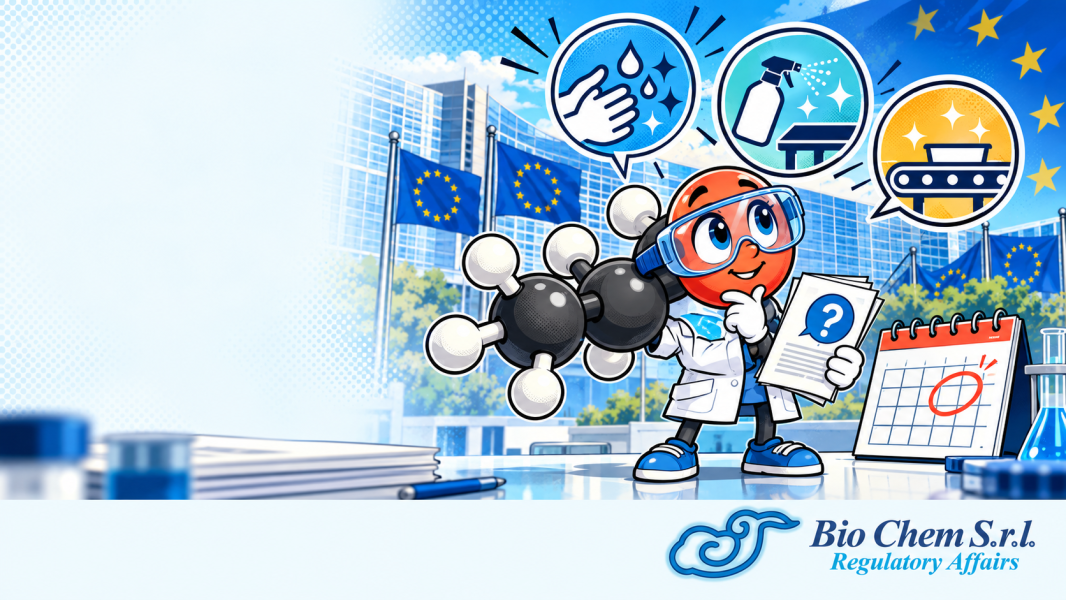
The proposal concerns the use of ethanol in the following Product Types:
Ethanol is currently listed by ECHA as a substance under the Review Programme, and its approval procedure is still recorded as “Initial application for approval in progress – Commission decision”.
Approval Period and Purity Requirements
If adopted, the proposal provides for an approval period running from 1 May 2028 to 30 April 2038. The active substance under assessment is also required to meet a minimum purity level of 92.6% w/w, corresponding to 95.1% v/v. It is important to clarify that this value refers to the active substance assessed for approval purposes and does not automatically represent the minimum concentration required in every biocidal product containing ethanol. The authorisation of individual biocidal products remains a separate regulatory procedure.
ECHA’s Assessment
In February 2026, ECHA’s Biocidal Products Committee (BPC) adopted its opinion on ethanol. The assessment considered the substance’s hazard properties, the risks associated with representative uses across the three Product Types, and the efficacy of the relevant products. The BPC supported the approval of ethanol for PTs 1, 2 and 4. However, the assessment did not allow the Committee to reach a definitive conclusion regarding the substance’s carcinogenic and reproductive toxicity properties. Among other factors, this uncertainty is associated with differences between the main exposure routes addressed by the available data and those relevant to the use of ethanol in biocidal products, particularly dermal and inhalation exposure.
Despite these uncertainties, the review procedure has not been suspended, and the European Commission’s proposal is progressing towards the possible approval of the substance.
Considerations Regarding Exposure Scenarios
During the subsequent authorisation of individual biocidal products, the competent authorities will need to pay particular attention to exposure scenarios, risks and efficacy in relation to uses that have not been adequately covered by the assessment conducted at Union level. For PTs 2 and 4, particular consideration is also required regarding the potential exposure of children. This is an important consideration because the possible approval of ethanol as an active substance will not automatically result in the authorisation of all biocidal products containing it. The BPR distinguishes between the approval of active substances and the subsequent authorisation of individual biocidal products.
Treated Articles
The proposal also addresses articles treated with ethanol or incorporating ethanol. Where the conditions laid down in the BPR are met, such articles are subject to the information and labelling requirements established under Article 58(3) of Regulation (EU) No 528/2012. The regulatory framework for treated articles forms an integral part of the BPR, which governs not only the approval of active substances and the authorisation of biocidal products, but also the placing on the market of treated articles.
Consultation and Next Steps
The European Commission’s proposal is currently undergoing consultation within the applicable procedure. The deadline for submitting comments is 23 November 2026, while adoption of the Implementing Regulation is currently scheduled for February 2027. The final conditions of approval will therefore only be known once the definitive legal act has been adopted and subsequently published in the Official Journal of the European Union.
Until then, ethanol should not be considered definitively approved at Union level for PTs 1, 2 and 4. ECHA likewise clarifies that the final decision on approval rests with the European Commission, on the basis of the BPC’s opinion.
Implications for Industry
Developments in the approval process are particularly relevant to companies that manufacture, formulate or market biocidal products containing ethanol, or intend to seek authorisation for such products in the sectors concerned. Depending on the product and its intended conditions of use, operators should monitor the adoption of the Implementing Regulation and proactively verify the following:
Sources and link
European Chemicals Agency (ECHA)
ECHA – Biocides: Ethanol e iter di approvazione
ECHA – Ethanol, Biocidal Active Substance Factsheet
ECHA – Biocidal Products Committee opinions on active substance approval
European Commission
Commissione europea – Active substances: procedura di approvazione